A Google matrix is a particular stochastic matrix that is used by Google's PageRank algorithm. The matrix represents a graph with edges representing links between pages. The PageRank of each page can then be generated iteratively from the Google matrix using the power method. However, in order for the power method to converge, the matrix must be stochastic, irreducible and aperiodic. == Adjacency matrix A and Markov matrix S == In order to generate the Google matrix G, we must first generate an adjacency matrix A which represents the relations between pages or nodes. Assuming there are N pages, we can fill out A by doing the following: A matrix element A i , j {\displaystyle A_{i,j}} is filled with 1 if node j {\displaystyle j} has a link to node i {\displaystyle i} , and 0 otherwise; this is the adjacency matrix of links. A related matrix S corresponding to the transitions in a Markov chain of given network is constructed from A by dividing the elements of column "j" by a number of k j = Σ i = 1 N A i , j {\displaystyle k_{j}=\Sigma _{i=1}^{N}A_{i,j}} where k j {\displaystyle k_{j}} is the total number of outgoing links from node j to all other nodes. The columns having zero matrix elements, corresponding to dangling nodes, are replaced by a constant value 1/N. Such a procedure adds a link from every sink, dangling state a {\displaystyle a} to every other node. Now by the construction the sum of all elements in any column of matrix S is equal to unity. In this way the matrix S is mathematically well defined and it belongs to the class of Markov chains and the class of Perron-Frobenius operators. That makes S suitable for the PageRank algorithm. == Construction of Google matrix G == Then the final Google matrix G can be expressed via S as: G i j = α S i j + ( 1 − α ) 1 N ( 1 ) {\displaystyle G_{ij}=\alpha S_{ij}+(1-\alpha ){\frac {1}{N}}\;\;\;\;\;\;\;\;\;\;\;(1)} By the construction the sum of all non-negative elements inside each matrix column is equal to unity. The numerical coefficient α {\displaystyle \alpha } is known as a damping factor. Usually S is a sparse matrix and for modern directed networks it has only about ten nonzero elements in a line or column, thus only about 10N multiplications are needed to multiply a vector by matrix G. == Examples of Google matrix == An example of the matrix S {\displaystyle S} construction via Eq.(1) within a simple network is given in the article CheiRank. For the actual matrix, Google uses a damping factor α {\displaystyle \alpha } around 0.85. The term ( 1 − α ) {\displaystyle (1-\alpha )} gives a surfer probability to jump randomly on any page. The matrix G {\displaystyle G} belongs to the class of Perron-Frobenius operators of Markov chains. The examples of Google matrix structure are shown in Fig.1 for Wikipedia articles hyperlink network in 2009 at small scale and in Fig.2 for University of Cambridge network in 2006 at large scale. == Spectrum and eigenstates of G matrix == For 0 < α < 1 {\displaystyle 0<\alpha <1} there is only one maximal eigenvalue λ = 1 {\displaystyle \lambda =1} with the corresponding right eigenvector which has non-negative elements P i {\displaystyle P_{i}} which can be viewed as stationary probability distribution. These probabilities ordered by their decreasing values give the PageRank vector P i {\displaystyle P_{i}} with the PageRank K i {\displaystyle K_{i}} used by Google search to rank webpages. Usually one has for the World Wide Web that P ∝ 1 / K β {\displaystyle P\propto 1/K^{\beta }} with β ≈ 0.9 {\displaystyle \beta \approx 0.9} . The number of nodes with a given PageRank value scales as N P ∝ 1 / P ν {\displaystyle N_{P}\propto 1/P^{\nu }} with the exponent ν = 1 + 1 / β ≈ 2.1 {\displaystyle \nu =1+1/\beta \approx 2.1} . The left eigenvector at λ = 1 {\displaystyle \lambda =1} has constant matrix elements. With 0 < α {\displaystyle 0<\alpha } all eigenvalues move as λ i → α λ i {\displaystyle \lambda _{i}\rightarrow \alpha \lambda _{i}} except the maximal eigenvalue λ = 1 {\displaystyle \lambda =1} , which remains unchanged. The PageRank vector varies with α {\displaystyle \alpha } but other eigenvectors with λ i < 1 {\displaystyle \lambda _{i}<1} remain unchanged due to their orthogonality to the constant left vector at λ = 1 {\displaystyle \lambda =1} . The gap between λ = 1 {\displaystyle \lambda =1} and other eigenvalue being 1 − α ≈ 0.15 {\displaystyle 1-\alpha \approx 0.15} gives a rapid convergence of a random initial vector to the PageRank approximately after 50 multiplications on G {\displaystyle G} matrix. At α = 1 {\displaystyle \alpha =1} the matrix G {\displaystyle G} has generally many degenerate eigenvalues λ = 1 {\displaystyle \lambda =1} (see e.g. [6]). Examples of the eigenvalue spectrum of the Google matrix of various directed networks is shown in Fig.3 from and Fig.4 from. The Google matrix can be also constructed for the Ulam networks generated by the Ulam method [8] for dynamical maps. The spectral properties of such matrices are discussed in [9,10,11,12,13,15]. In a number of cases the spectrum is described by the fractal Weyl law [10,12]. The Google matrix can be constructed also for other directed networks, e.g. for the procedure call network of the Linux Kernel software introduced in [15]. In this case the spectrum of λ {\displaystyle \lambda } is described by the fractal Weyl law with the fractal dimension d ≈ 1.3 {\displaystyle d\approx 1.3} (see Fig.5 from ). Numerical analysis shows that the eigenstates of matrix G {\displaystyle G} are localized (see Fig.6 from ). Arnoldi iteration method allows to compute many eigenvalues and eigenvectors for matrices of rather large size [13]. Other examples of G {\displaystyle G} matrix include the Google matrix of brain [17] and business process management [18], see also. Applications of Google matrix analysis to DNA sequences is described in [20]. Such a Google matrix approach allows also to analyze entanglement of cultures via ranking of multilingual Wikipedia articles abouts persons [21] == Historical notes == The Google matrix with damping factor was described by Sergey Brin and Larry Page in 1998 [22], see also articles on PageRank history [23], [24].
Grokking (machine learning)
In machine learning, grokking, or delayed generalization, is a phenomenon observed in some settings where a model abruptly transitions from overfitting (performing well only on training data) to generalizing (performing well on both training and test data), after many training iterations with little or no improvement on the held-out data. This contrasts with what is typically observed in machine learning, where generalization occurs gradually alongside improved performance on training data. == Origin == Grokking was introduced by OpenAI researcher Alethea Power and colleagues in the January 2022 paper "Grokking: Generalization Beyond Overfitting on Small Algorithmic Datasets". It is derived from the word grok coined by Robert Heinlein in his novel Stranger in a Strange Land. In ML research, "grokking" is not used as a synonym for "generalization"; rather, it names a sometimes-observed delayed‑generalization training phenomenon in which training and held‑out performance do not improve in tandem, and in which held‑out performance rises abruptly later. Authors also analyze the "grokking time", the epoch or step at which this transition occurs in those scenarios. == Interpretations == Grokking can be understood as a phase transition during the training process. In particular, recent work has shown that grokking may be due to a complexity phase transition in the model during training. While grokking has been thought of as largely a phenomenon of relatively shallow models, grokking has been observed in deep neural networks and non-neural models and is the subject of active research. One potential explanation is that the weight decay (a component of the loss function that penalizes higher values of the neural network parameters, also called regularization) slightly favors the general solution that involves lower weight values, but that is also harder to find. According to Neel Nanda, the process of learning the general solution may be gradual, even though the transition to the general solution occurs more suddenly later. Recent theories have hypothesized that grokking occurs when neural networks transition from a "lazy training" regime where the weights do not deviate far from initialization, to a "rich" regime where weights abruptly begin to move in task-relevant directions. Follow-up empirical and theoretical work has accumulated evidence in support of this perspective, and it offers a unifying view of earlier work as the transition from lazy to rich training dynamics is known to arise from properties of adaptive optimizers, weight decay, initial parameter weight norm, and more. This perspective is complementary to a unifying "pattern learning speeds" framework that links grokking and double descent; within this view, delayed generalization can arise across training time ("epoch‑wise") or across model size ("model‑wise"), and the authors report "model‑wise grokking".
Pixel-art scaling algorithms
Pixel art scaling algorithms are graphical filters that attempt to enhance the appearance of hand-drawn 2D pixel art graphics. These algorithms are a form of automatic image enhancement. Pixel art scaling algorithms employ methods significantly different than the common methods of image rescaling, which have the goal of preserving the appearance of images. As pixel art graphics are commonly used at very low resolutions, they employ careful coloring of individual pixels. This results in graphics that rely on a high amount of stylized visual cues to define complex shapes. Several specialized algorithms have been developed to handle re-scaling of such graphics. These specialized algorithms can improve the appearance of pixel-art graphics, but in doing so they introduce changes. Such changes may be undesirable, especially if the goal is to faithfully reproduce the original appearance. Since a typical application of this technology is improving the appearance of fourth-generation and earlier video games on arcade and console emulators, many pixel art scaling algorithms are designed to run in real-time for sufficiently small input images at 60-frames per second. This places constraints on the type of programming techniques that can be used for this sort of real-time processing. Many work only on specific scale factors. 2× is the most common scale factor, while 3×, 4×, 5×, and 6× exist but are less used. == Algorithms == === SAA5050 'Diagonal Smoothing' === The Mullard SAA5050 Teletext character generator chip (1980) used a primitive pixel scaling algorithm to generate higher-resolution characters on the screen from a lower-resolution representation from its internal ROM. Internally, each character shape was defined on a 5 × 9 pixel grid, which was then interpolated by smoothing diagonals to give a 10 × 18 pixel character, with a characteristically angular shape, surrounded to the top and the left by two pixels of blank space. The algorithm only works on monochrome source data, and assumes the source pixels will be logically true or false depending on whether they are 'on' or 'off'. Pixels 'outside the grid pattern' are assumed to be off. The algorithm works as follows: A B C --\ 1 2 D E F --/ 3 4 1 = B | (A & E & !B & !D) 2 = B | (C & E & !B & !F) 3 = E | (!A & !E & B & D) 4 = E | (!C & !E & B & F) Note that this algorithm, like the Eagle algorithm below, has a flaw: If a pattern of 4 pixels in a hollow diamond shape appears, the hollow will be obliterated by the expansion. The SAA5050's internal character ROM carefully avoids ever using this pattern. The degenerate case: becomes: === EPX/Scale2×/AdvMAME2× === Eric's Pixel Expansion (EPX) is an algorithm developed by Eric Johnston at LucasArts around 1992, when porting the SCUMM engine games from the IBM PC (which ran at 320 × 200 × 256 colors) to the early color Macintosh computers, which ran at more or less double that resolution. The algorithm works as follows, expanding P into 4 new pixels based on P's surroundings: 1=P; 2=P; 3=P; 4=P; IF C==A => 1=A IF A==B => 2=B IF D==C => 3=C IF B==D => 4=D IF of A, B, C, D, three or more are identical: 1=2=3=4=P Later implementations of this same algorithm (as AdvMAME2× and Scale2×, developed around 2001) are slightly more efficient but functionally identical: 1=P; 2=P; 3=P; 4=P; IF C==A AND C!=D AND A!=B => 1=A IF A==B AND A!=C AND B!=D => 2=B IF D==C AND D!=B AND C!=A => 3=C IF B==D AND B!=A AND D!=C => 4=D AdvMAME2× is available in DOSBox via the scaler=advmame2x dosbox.conf option. The AdvMAME4×/Scale4× algorithm is just EPX applied twice to get 4× resolution. ==== Scale3×/AdvMAME3× and ScaleFX ==== The AdvMAME3×/Scale3× algorithm (available in DOSBox via the scaler=advmame3x dosbox.conf option) can be thought of as a generalization of EPX to the 3× case. The corner pixels are calculated identically to EPX. 1=E; 2=E; 3=E; 4=E; 5=E; 6=E; 7=E; 8=E; 9=E; IF D==B AND D!=H AND B!=F => 1=D IF (D==B AND D!=H AND B!=F AND E!=C) OR (B==F AND B!=D AND F!=H AND E!=A) => 2=B IF B==F AND B!=D AND F!=H => 3=F IF (H==D AND H!=F AND D!=B AND E!=A) OR (D==B AND D!=H AND B!=F AND E!=G) => 4=D 5=E IF (B==F AND B!=D AND F!=H AND E!=I) OR (F==H AND F!=B AND H!=D AND E!=C) => 6=F IF H==D AND H!=F AND D!=B => 7=D IF (F==H AND F!=B AND H!=D AND E!=G) OR (H==D AND H!=F AND D!=B AND E!=I) => 8=H IF F==H AND F!=B AND H!=D => 9=F There is also a variant improved over Scale3× called ScaleFX, developed by Sp00kyFox, and a version combined with Reverse-AA called ScaleFX-Hybrid. === Eagle === Eagle works as follows: for every in pixel, we will generate 4 out pixels. First, set all 4 to the color of the pixel we are currently scaling (as nearest-neighbor). Next look at the three pixels above, to the left, and diagonally above left: if all three are the same color as each other, set the top left pixel of our output square to that color in preference to the nearest-neighbor color. Work similarly for all four pixels, and then move to the next one. Assume an input matrix of 3 × 3 pixels where the centermost pixel is the pixel to be scaled, and an output matrix of 2 × 2 pixels (i.e., the scaled pixel) first: |Then . . . --\ CC |S T U --\ 1 2 . C . --/ CC |V C W --/ 3 4 . . . |X Y Z | IF V==S==T => 1=S | IF T==U==W => 2=U | IF V==X==Y => 3=X | IF W==Z==Y => 4=Z Thus if we have a single black pixel on a white background it will vanish. This is a bug in the Eagle algorithm but is solved by other algorithms such as EPX, 2xSaI, and HQ2x. === 2×SaI === 2×SaI, short for 2× Scale and Interpolation engine, was inspired by Eagle. It was designed by Derek Liauw Kie Fa, also known as Kreed, primarily for use in console and computer emulators, and it has remained fairly popular in this niche. Many of the most popular emulators, including ZSNES and VisualBoyAdvance, offer this scaling algorithm as a feature. Several slightly different versions of the scaling algorithm are available, and these are often referred to as Super 2×SaI and Super Eagle. The 2xSaI family works on a 4 × 4 matrix of pixels where the pixel marked A below is scaled: I E F J G A B K --\ W X H C D L --/ Y Z M N O P For 16-bit pixels, they use pixel masks which change based on whether the 16-bit pixel format is 565 or 555. The constants colorMask, lowPixelMask, qColorMask, qLowPixelMask, redBlueMask, and greenMask are 16-bit masks. The lower 8 bits are identical in either pixel format. Two interpolation functions are described: INTERPOLATE(uint32 A, UINT32 B). -- linear midpoint of A and B if (A == B) return A; return ( ((A & colorMask) >> 1) + ((B & colorMask) >> 1) + (A & B & lowPixelMask) ); Q_INTERPOLATE(uint32 A, uint32 B, uint32 C, uint32 D) -- bilinear interpolation; A, B, C, and D's average x = ((A & qColorMask) >> 2) + ((B & qColorMask) >> 2) + ((C & qColorMask) >> 2) + ((D & qColorMask) >> 2); y = (A & qLowPixelMask) + (B & qLowPixelMask) + (C & qLowPixelMask) + (D & qLowPixelMask); y = (y >> 2) & qLowPixelMask; return x + y; The algorithm checks A, B, C, and D for a diagonal match such that A==D and B!=C, or the other way around, or if they are both diagonals or if there is no diagonal match. Within these, it checks for three or four identical pixels. Based on these conditions, the algorithm decides whether to use one of A, B, C, or D, or an interpolation among only these four, for each output pixel. The 2xSaI arbitrary scaler can enlarge any image to any resolution and uses bilinear filtering to interpolate pixels. Since Kreed released the source code under the GNU General Public License, it is freely available to anyone wishing to utilize it in a project released under that license. Developers wishing to use it in a non-GPL project would be required to rewrite the algorithm without using any of Kreed's existing code. It is available in DOSBox via scaler=2xsai option. === hqnx family === Maxim Stepin's hq2x, hq3x, and hq4x are for scale factors of 2:1, 3:1, and 4:1 respectively. Each work by comparing the color value of each pixel to those of its eight immediate neighbors, marking the neighbors as close or distant, and using a pre-generated lookup table to find the proper proportion of input pixels' values for each of the 4, 9 or 16 corresponding output pixels. The hq3x family will perfectly smooth any diagonal line whose slope is ±0.5, ±1, or ±2 and which is not anti-aliased in the input; one with any other slope will alternate between two slopes in the output. It will also smooth very tight curves. Unlike 2xSaI, it anti-aliases the output. hqnx was initially created for the Super NES emulator ZSNES. The author of bsnes has released a space-efficient implementation of hq2x to the public domain. A port to shaders, which has comparable quality to the early versions of xBR, is available. Before the port, a shader called "scalehq" has often been confused for hqx. === xBR family === There are 6 filters in this family: xBR , xBRZ, xBR-Hybrid, Super xBR, xBR+3D and Super xBR+3D. xBR ("scale by rules"), cre
CineAsset
CineAsset was a complete mastering software suite by Doremi Labs that could create and playback encrypted (Pro version) and unencrypted DCI compliant packages from virtually any source. CineAsset included a separate "Editor" application for generating Digital Cinema Packages (DCPs). CineAsset Pro added the ability to generate encrypted DCPs and Key Delivery Messages (KDMs) for any encrypted content in the database. It has since been discontinued, along with CineAsset Player. == Features == == Supported formats == === Input === Source: ==== Containers ==== AVI MOV MXF MPG TS WMV M2TS MTS MP4 MKV ==== Video Codecs ==== JPEG2000 ProRes 422 DNxHD® YUV Uncompressed 8-10 bits DIVX® XVID® MPEG4 AVC / H-264 VC-1 MPEG2 ==== Image Sequences ==== BMP TIFF TGA DPX JPG J2C ==== Audio Files ==== WAV MP3 WMA MP2 === Output === Source: ==== JPEG2000 ==== 2D and 3D at up to 4K resolution Bit Rate: 50–250 Mbit/s (500 Mbit/s for frame rates above 30 fps) Speed: Faster than real-time processing when using optional render nodes ==== MPEG2 ==== I-Only or Long GOP 1080p up to 80 Mbit/s ==== H264 ==== 1080p up to 50 Mbit/s ==== VC1 ==== DCP wrapping only (no transcode)
COVID-19 apps
COVID-19 apps include mobile-software applications for digital contact-tracing—i.e. the process of identifying persons ("contacts") who may have been in contact with an infected individual—deployed during the COVID-19 pandemic. Numerous tracing applications have been developed or proposed, with official government support in some territories and jurisdictions. Several frameworks for building contact-tracing apps have been developed. Privacy concerns have been raised, especially about systems that are based on tracking the geographical location of app users. Less overtly intrusive alternatives include the co-option of Bluetooth signals to log a user's proximity to other cellphones. (Bluetooth technology has form in tracking cell-phones' locations.)) On 10 April 2020, Google and Apple jointly announced that they would integrate functionality to support such Bluetooth-based apps directly into their Android and iOS operating systems. India's COVID-19 tracking app Aarogya Setu became the world's fastest growing application—beating Pokémon Go—with 50 million users in the first 13 days of its release. == Rationale == Contact tracing is an important tool in infectious disease control, but as the number of cases rises time constraints make it more challenging to effectively control transmission. Digital contact tracing, especially if widely deployed, may be more effective than traditional methods of contact tracing. In a March 2020 model by the University of Oxford Big Data Institute's Christophe Fraser's team, a coronavirus outbreak in a city of one million people is halted if 80% of all smartphone users take part in a tracking system; in the model, the elderly are still expected to self-isolate en masse, but individuals who are neither symptomatic nor elderly are exempt from isolation unless they receive an alert that they are at risk of carrying the disease. Some proponents advocate for legislation exempting certain COVID-19 apps from general privacy restrictions. == Issues == === Uptake === Ross Anderson, professor of security engineering at Cambridge University, listed a number of potential practical problems with app-based systems, including false positives and the potential lack of effectiveness if takeup of the app is limited to only a small fraction of the population. In Singapore, only one person in three had downloaded the TraceTogether app by the end of June 2020, despite legal requirements for most workers; the app was also underused, as it required users to keep it open at all times on iOS. A team at the University of Oxford simulated the effect of a contact tracing app on a city of 1 million. They estimated that if the app was used in conjunction with the shielding of over-70s, then 56% of the population would have to be using the app for it to suppress the virus. This would be equivalent to 80% of smartphone users in the United Kingdom. They found that the app could still slow the spread of the virus if fewer people downloaded it, with one infection being prevented for every one or two users. In August 2020, the American Civil Liberties Union (ACLU) argued that there were disparities in smartphone use between demographics and minority groups, and that "even the most comprehensive, all-seeing contact tracing system is of little use without social and medical systems in place to help those who may have the virus — including access to medical care, testing, and support for those who are quarantined." === App store restrictions === Addressing concerns about the spread of misleading or harmful apps, Apple, Google and Amazon set limits on which types of organizations could add coronavirus-related apps to its App Store, limiting them to only "official" or otherwise reputable organizations. === Ethical principles of mass surveillance using COVID-19 contact tracing apps === The advent of COVID-19 contact tracing apps has led to concerns around privacy, the rights of app users, and governmental authority. The European Convention on Human Rights, the International Covenant on Civil and Political Rights (ICCPR) and the United Nations and the Siracusa Principles have outlined 4 principles to consider when looking at the ethical principles of mass surveillance with COVID-19 contact tracing apps. These are necessity, proportionality, scientific validity, and time boundedness. Necessity is defined as the idea that governments should only interfere with a person's rights when deemed essential for public health interests. The potential risks associated with infringements of personal privacy must be outweighed by the possibility of reducing significant harm to others. Potential benefits of contact-tracing apps that may be considered include allowing for blanket population-level quarantine measures to be lifted sooner and the minimization of people under quarantine. Hence, some contend that contact-tracing apps are justified as they may be less intrusive than blanket quarantine measures. Furthermore, the delay of an effective contact-tracing app with significant health and economic benefits may be considered unethical. Proportionality refers to the concept that a contact tracing app's potential negative impact on a person's rights should be justifiable by the severity of the health risks that are being addressed. Apps must use the most privacy-preserving options available to achieve their goals, and the selected option should not only be a logical option for achieving the goal but also an effective one. Scientific validity evaluates whether an app is effective, timely and accurate. Traditional manual contact-tracing procedures are not efficient enough for the COVID-19 pandemic, and do not consider asymptomatic transmission. Contact-tracing apps, on the other hand, can be effective COVID-19 contact-tracing tools that reduce R value to less than 1, leading to sustained epidemic suppression. However, for apps to be effective, there needs to be a minimum 56-60% uptake in the population. Apps should be continually modified to reflect current knowledge on the diseases being monitored. Some argue that contact-tracing apps should be considered societal experimental trials where results and adverse effects are evaluated according to the stringent guidelines of social experiments. Analyses should be conducted by independent research bodies and published for wide dissemination. Despite the current urgency of our pandemic situation, we should still adhere to the standard rigors of scientific evaluation. Time boundedness describe the need for establishing legal and technical sunset clauses so that they are only allowed to operate as long as necessary to address the pandemic situation. Apps should be withdrawn as soon as possible after the end of the pandemic. If the end of the pandemic cannot be predicted, the use of apps should be regularly reviewed and decisions about continued use should be made at each review. Collected data should only be retained by public health authorities for research purposes with clear stipulations on how long the data will be held for and who will be responsible for security, oversight, and ownership. === Privacy, discrimination and marginalisation concerns === The American Civil Liberties Union (ACLU) has published a set of principles for technology-assisted contact tracing and Amnesty International and over 100 other organizations issued a statement calling for limits on this kind of surveillance. The organisations declared eight conditions on governmental projects: surveillance would have to be "lawful, necessary and proportionate"; extensions of monitoring and surveillance would have to have sunset clauses; the use of data would have to be limited to COVID-19 purposes; data security and anonymity would have to be protected and shown to be protected based on evidence; digital surveillance would have to address the risk of exacerbating discrimination and marginalisation; any sharing of data with third parties would have to be defined in law; there would have to be safeguards against abuse and the rights of citizens to respond to abuses; "meaningful participation" by all "relevant stakeholders" would be required, including that of public health experts and marginalised groups. The German Chaos Computer Club (CCC) and Reporters Without Borders also issued checklists. The Exposure Notification service intends to address the problem of persistent surveillance by removing the tracing mechanism from their device operating systems once it is no longer needed. On 20 April 2020, it was reported that over 300 academics had signed a statement favouring decentralised proximity tracing applications over centralised models, given the difficulty in precluding centralised options being used "to enable unwarranted discrimination and surveillance." In a centralised model, a central database records the ID codes of meetings between users. In a decentralised model, this information is recorded on individual phones, with the role of the central
DaVinci (software)
DaVinci was a development tool produced by Incross, which aimed at creating HTML5 mobile applications and media content. It included a jQuery framework and a JavaScript library that enabled developers and designers to craft web applications designed for mobile devices with a user experience similar to native applications. Business applications, games, rich media content, such as HTML5 multi-media magazines, advertisements, and animation, may be produced with the tool. DaVinci was based on standard web technology – including HTML5, CSS3, and JavaScript. == Features == DaVinci comprised DaVinci Studio and DaVinci Animator, which handled application programming and UI design. The tool had a WYSIWYG authoring environment. Open-source libraries, such as KnockOut, JsRender/JsViews, Impress.js, and turn.js, were included in the tool. Other open-source frameworks could also be integrated. The Model View Controller (MVC) and Data Binding in JavaScript could be handled through DaVinci's Data-Set Editor. In this mode, view components and model data could be visually bound, which allowed users to create web applications with server-integrated UI components without coding. Additionally, DaVinci included an N-Screen editor, which automatically adjusted designs and functionalities to fit the screen sizes of various devices, including smartphones, tablet PCs, and TVs. == DaVinci and jQuery == In collaboration with the jQuery Foundation, DaVinci played a significant role in hosting the first jQuery conference in an Asian district, which took place on November 12, 2012, in Seoul, South Korea. The conference showcased how DaVinci could be utilized in application development demonstrations.
Human–robot interaction
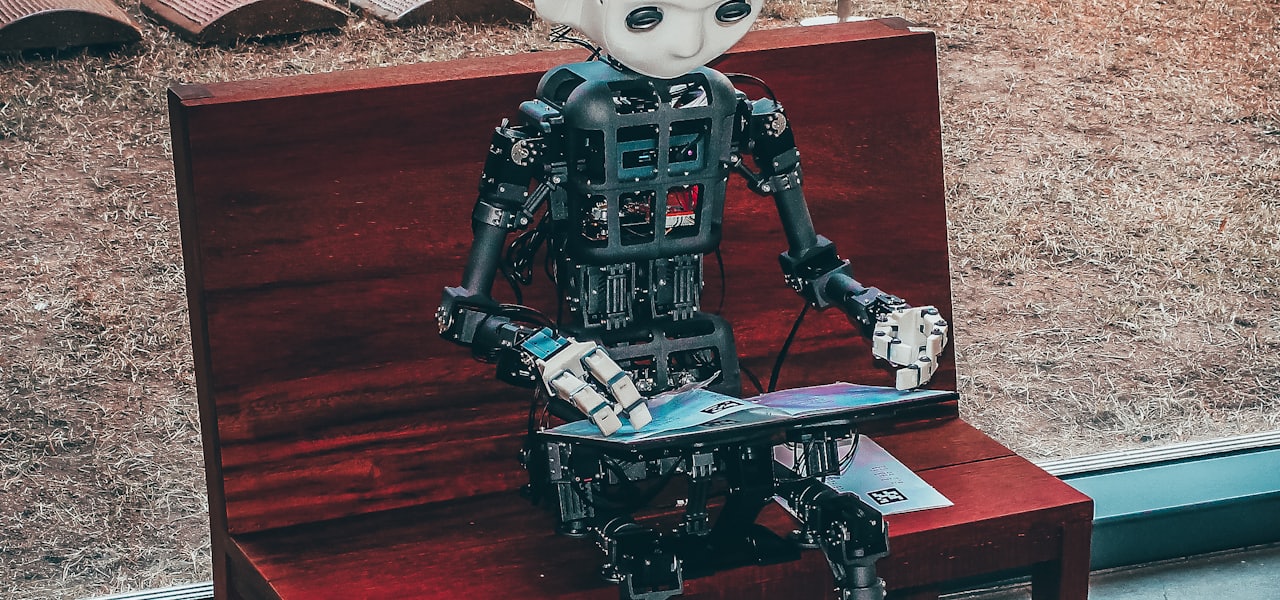
Human–robot interaction (HRI) is the study of interactions between humans and robots. Human–robot interaction is a multidisciplinary field with contributions from human–computer interaction, artificial intelligence, robotics, natural language processing, design, psychology and philosophy. A subfield known as physical human–robot interaction (pHRI) has tended to focus on device design to enable people to safely interact with robotic systems. == Origins == Human–robot interaction has been a topic of both science fiction and academic speculation even before any robots existed. Because much of active HRI development depends on natural language processing, many aspects of HRI are continuations of human communications, a field of research which is much older than robotics. The origin of HRI as a discrete problem was stated by 20th-century author Isaac Asimov in 1941, in his novel I, Robot. Asimov coined Three Laws of Robotics, namely: A robot may not injure a human being or, through inaction, allow a human being to come to harm. A robot must obey the orders given it by human beings except where such orders would conflict with the First Law. A robot must protect its own existence as long as such protection does not conflict with the First or Second Laws. These three laws provide an overview of the goals engineers and researchers hold for safety in the HRI field, although the fields of robot ethics and machine ethics are more complex than these three principles. However, generally human–robot interaction prioritizes the safety of humans that interact with potentially dangerous robotics equipment. Solutions to this problem range from the philosophical approach of treating robots as ethical agents (individuals with moral agency), to the practical approach of creating safety zones. These safety zones use technologies such as lidar to detect human presence or physical barriers to protect humans by preventing any contact between machine and operator. Although initially robots in the human–robot interaction field required some human intervention to function, research has expanded this to the extent that fully autonomous systems are now far more common than in the early 2000s. Autonomous systems include from simultaneous localization and mapping systems which provide intelligent robot movement to natural-language processing and natural-language generation systems which allow for natural, human-esque interaction which meet well-defined psychological benchmarks. Anthropomorphic robots (machines which imitate human body structure) are better described by the biomimetics field, but overlap with HRI in many research applications. Examples of robots which demonstrate this trend include Willow Garage's PR2 robot, the NASA Robonaut, and Honda ASIMO. However, robots in the human–robot interaction field are not limited to human-like robots: Paro and Kismet are both robots designed to elicit emotional response from humans, and so fall into the category of human–robot interaction. Goals in HRI range from industrial manufacturing through Cobots, medical technology through rehabilitation, autism intervention, and elder care devices, entertainment, human augmentation, and human convenience. Future research therefore covers a wide range of fields, much of which focuses on assistive robotics, robot-assisted search-and-rescue, and space exploration. == The goal of friendly human–robot interactions == Robots are artificial agents with capacities of perception and action in the physical world often referred by researchers as workspace. Their use has been generalized in factories but nowadays they tend to be found in the most technologically advanced societies in such critical domains as search and rescue, military battle, mine and bomb detection, scientific exploration, law enforcement, entertainment and hospital care. These new domains of applications imply a closer interaction with the user, sharing the workspace but also goals in terms of task achievement. The subfield of physical human–robot interaction (pHRI) has largely focused on device design to enable people to safely interact with robotic systems but is increasingly developing algorithmic approaches in an attempt to support fluent and expressive interactions between humans and robotic systems. With the advance in AI, the research is focusing on one part towards the safest physical interaction but also on a socially correct interaction, dependent on cultural criteria. The goal is to build an intuitive, and easy communication with the robot through speech, gestures, and facial expressions. Kerstin Dautenhahn refers to friendly Human–robot interaction as "Robotiquette" defining it as the "social rules for robot behaviour (a 'robotiquette') that is comfortable and acceptable to humans" The robot has to adapt itself to our way of expressing desires and orders and not the contrary. But every day environments such as homes have much more complex social rules than those implied by factories or even military environments. Thus, the robot needs perceiving and understanding capacities to build dynamic models of its surroundings. It needs to categorize objects, recognize and locate humans and further recognize their emotions. The need for dynamic capacities pushes forward every sub-field of robotics. Furthermore, by understanding and perceiving social cues, robots can enable collaborative scenarios with humans. For example, with the rapid rise of personal fabrication machines such as desktop 3D printers, laser cutters, etc., entering our homes, scenarios may arise where robots can collaboratively share control, co-ordinate and achieve tasks together. Industrial robots have already been integrated into industrial assembly lines and are collaboratively working with humans. The social impact of such robots have been studied and has indicated that workers still treat robots and social entities, rely on social cues to understand and work together. On the other end of HRI research the cognitive modelling of the "relationship" between human and the robots benefits the psychologists and robotic researchers the user study are often of interests on both sides. This research endeavours part of human society. For effective human – humanoid robot interaction numerous communication skills and related features should be implemented in the design of such artificial agents/systems. == General HRI research == HRI research spans a wide range of fields, some general to the nature of HRI. === Methods for perceiving humans === Methods for perceiving humans in the environment are based on sensor information. Research on sensing components and software led by Microsoft provide useful results for extracting the human kinematics (see Kinect). An example of older technique is to use colour information for example the fact that for light skinned people the hands are lighter than the clothes worn. In any case a human modelled a priori can then be fitted to the sensor data. The robot builds or has (depending on the level of autonomy the robot has) a 3D mapping of its surroundings to which is assigned the humans locations. Most methods intend to build a 3D model through vision of the environment. The proprioception sensors permit the robot to have information over its own state. This information is relative to a reference. Theories of proxemics may be used to perceive and plan around a person's personal space. A speech recognition system is used to interpret human desires or commands. By combining the information inferred by proprioception, sensor and speech the human position and state (standing, seated). In this matter, natural-language processing is concerned with the interactions between computers and human (natural) languages, in particular how to program computers to process and analyze large amounts of natural-language data. For instance, neural-network architectures and learning algorithms that can be applied to various natural-language processing tasks including part-of-speech tagging, chunking, named-entity recognition, and semantic role labeling. === Methods for motion planning === Motion planning in dynamic environments is a challenge that can at the moment only be achieved for robots with 3 to 10 degrees of freedom. Humanoid robots or even 2 armed robots, which can have up to 40 degrees of freedom, are unsuited for dynamic environments with today's technology. However lower-dimensional robots can use the potential field method to compute trajectories which avoid collisions with humans. === Cognitive models and theory of mind === Humans exhibit negative social and emotional responses as well as decreased trust toward some robots that closely, but imperfectly, resemble humans; this phenomenon has been termed the "Uncanny Valley". However recent research in telepresence robots has established that mimicking human body postures and expressive gestures has made the robots likeable and engaging in a remote setting. Further, the presence o