Toggl Track (formerly Toggl) is a time tracking software developed by Toggl OÜ which is headquartered in Tallinn, Estonia. The company offers online time tracking and reporting services through their website along with mobile and desktop applications. Time can be tracked through a start/stop button, manual entry, or dragging and resizing time blocks in a calendar view. == History == According to Alari Aho, Toggl's CEO and founder, the application has been fully self-funded from the start. The name was created using a random name generator.
Human–robot interaction
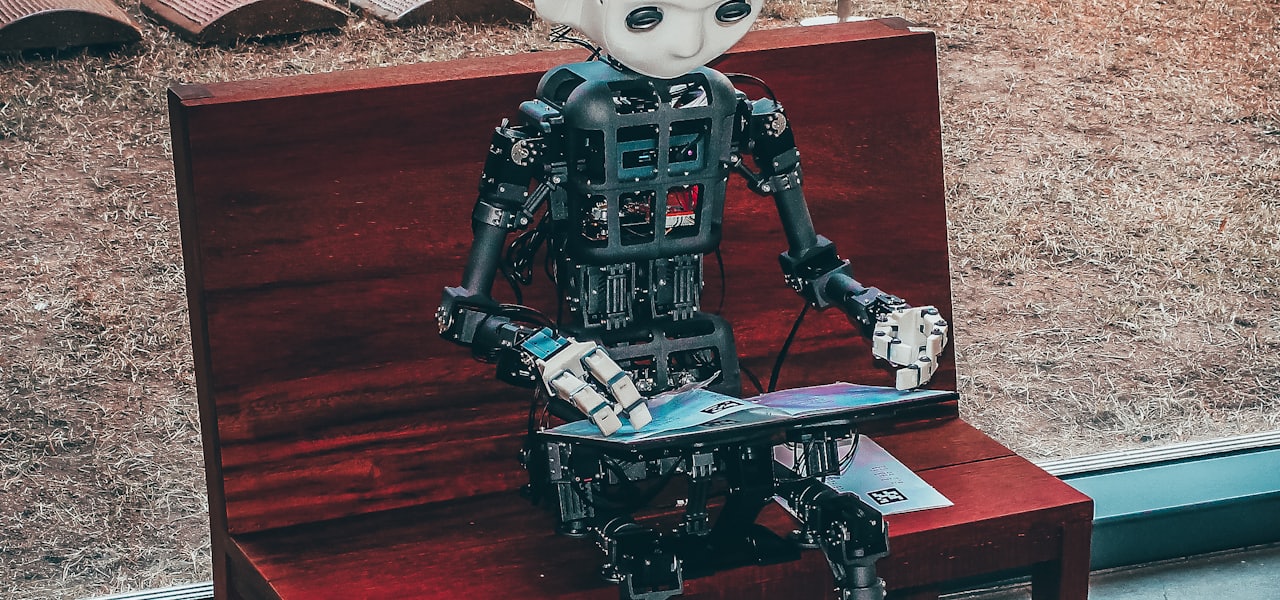
Human–robot interaction (HRI) is the study of interactions between humans and robots. Human–robot interaction is a multidisciplinary field with contributions from human–computer interaction, artificial intelligence, robotics, natural language processing, design, psychology and philosophy. A subfield known as physical human–robot interaction (pHRI) has tended to focus on device design to enable people to safely interact with robotic systems. == Origins == Human–robot interaction has been a topic of both science fiction and academic speculation even before any robots existed. Because much of active HRI development depends on natural language processing, many aspects of HRI are continuations of human communications, a field of research which is much older than robotics. The origin of HRI as a discrete problem was stated by 20th-century author Isaac Asimov in 1941, in his novel I, Robot. Asimov coined Three Laws of Robotics, namely: A robot may not injure a human being or, through inaction, allow a human being to come to harm. A robot must obey the orders given it by human beings except where such orders would conflict with the First Law. A robot must protect its own existence as long as such protection does not conflict with the First or Second Laws. These three laws provide an overview of the goals engineers and researchers hold for safety in the HRI field, although the fields of robot ethics and machine ethics are more complex than these three principles. However, generally human–robot interaction prioritizes the safety of humans that interact with potentially dangerous robotics equipment. Solutions to this problem range from the philosophical approach of treating robots as ethical agents (individuals with moral agency), to the practical approach of creating safety zones. These safety zones use technologies such as lidar to detect human presence or physical barriers to protect humans by preventing any contact between machine and operator. Although initially robots in the human–robot interaction field required some human intervention to function, research has expanded this to the extent that fully autonomous systems are now far more common than in the early 2000s. Autonomous systems include from simultaneous localization and mapping systems which provide intelligent robot movement to natural-language processing and natural-language generation systems which allow for natural, human-esque interaction which meet well-defined psychological benchmarks. Anthropomorphic robots (machines which imitate human body structure) are better described by the biomimetics field, but overlap with HRI in many research applications. Examples of robots which demonstrate this trend include Willow Garage's PR2 robot, the NASA Robonaut, and Honda ASIMO. However, robots in the human–robot interaction field are not limited to human-like robots: Paro and Kismet are both robots designed to elicit emotional response from humans, and so fall into the category of human–robot interaction. Goals in HRI range from industrial manufacturing through Cobots, medical technology through rehabilitation, autism intervention, and elder care devices, entertainment, human augmentation, and human convenience. Future research therefore covers a wide range of fields, much of which focuses on assistive robotics, robot-assisted search-and-rescue, and space exploration. == The goal of friendly human–robot interactions == Robots are artificial agents with capacities of perception and action in the physical world often referred by researchers as workspace. Their use has been generalized in factories but nowadays they tend to be found in the most technologically advanced societies in such critical domains as search and rescue, military battle, mine and bomb detection, scientific exploration, law enforcement, entertainment and hospital care. These new domains of applications imply a closer interaction with the user, sharing the workspace but also goals in terms of task achievement. The subfield of physical human–robot interaction (pHRI) has largely focused on device design to enable people to safely interact with robotic systems but is increasingly developing algorithmic approaches in an attempt to support fluent and expressive interactions between humans and robotic systems. With the advance in AI, the research is focusing on one part towards the safest physical interaction but also on a socially correct interaction, dependent on cultural criteria. The goal is to build an intuitive, and easy communication with the robot through speech, gestures, and facial expressions. Kerstin Dautenhahn refers to friendly Human–robot interaction as "Robotiquette" defining it as the "social rules for robot behaviour (a 'robotiquette') that is comfortable and acceptable to humans" The robot has to adapt itself to our way of expressing desires and orders and not the contrary. But every day environments such as homes have much more complex social rules than those implied by factories or even military environments. Thus, the robot needs perceiving and understanding capacities to build dynamic models of its surroundings. It needs to categorize objects, recognize and locate humans and further recognize their emotions. The need for dynamic capacities pushes forward every sub-field of robotics. Furthermore, by understanding and perceiving social cues, robots can enable collaborative scenarios with humans. For example, with the rapid rise of personal fabrication machines such as desktop 3D printers, laser cutters, etc., entering our homes, scenarios may arise where robots can collaboratively share control, co-ordinate and achieve tasks together. Industrial robots have already been integrated into industrial assembly lines and are collaboratively working with humans. The social impact of such robots have been studied and has indicated that workers still treat robots and social entities, rely on social cues to understand and work together. On the other end of HRI research the cognitive modelling of the "relationship" between human and the robots benefits the psychologists and robotic researchers the user study are often of interests on both sides. This research endeavours part of human society. For effective human – humanoid robot interaction numerous communication skills and related features should be implemented in the design of such artificial agents/systems. == General HRI research == HRI research spans a wide range of fields, some general to the nature of HRI. === Methods for perceiving humans === Methods for perceiving humans in the environment are based on sensor information. Research on sensing components and software led by Microsoft provide useful results for extracting the human kinematics (see Kinect). An example of older technique is to use colour information for example the fact that for light skinned people the hands are lighter than the clothes worn. In any case a human modelled a priori can then be fitted to the sensor data. The robot builds or has (depending on the level of autonomy the robot has) a 3D mapping of its surroundings to which is assigned the humans locations. Most methods intend to build a 3D model through vision of the environment. The proprioception sensors permit the robot to have information over its own state. This information is relative to a reference. Theories of proxemics may be used to perceive and plan around a person's personal space. A speech recognition system is used to interpret human desires or commands. By combining the information inferred by proprioception, sensor and speech the human position and state (standing, seated). In this matter, natural-language processing is concerned with the interactions between computers and human (natural) languages, in particular how to program computers to process and analyze large amounts of natural-language data. For instance, neural-network architectures and learning algorithms that can be applied to various natural-language processing tasks including part-of-speech tagging, chunking, named-entity recognition, and semantic role labeling. === Methods for motion planning === Motion planning in dynamic environments is a challenge that can at the moment only be achieved for robots with 3 to 10 degrees of freedom. Humanoid robots or even 2 armed robots, which can have up to 40 degrees of freedom, are unsuited for dynamic environments with today's technology. However lower-dimensional robots can use the potential field method to compute trajectories which avoid collisions with humans. === Cognitive models and theory of mind === Humans exhibit negative social and emotional responses as well as decreased trust toward some robots that closely, but imperfectly, resemble humans; this phenomenon has been termed the "Uncanny Valley". However recent research in telepresence robots has established that mimicking human body postures and expressive gestures has made the robots likeable and engaging in a remote setting. Further, the presence o
Jared Kaplan
Jared Daniel Kaplan is a theoretical physicist and artificial intelligence researcher. He is an associate professor in the Johns Hopkins University Department of Physics & Astronomy, and a co-founder and chief science officer of Anthropic. == Education == Kaplan attended the Illinois Mathematics and Science Academy during high school. He received a bachelor's degree in physics and mathematics from Stanford University and a PhD in physics from Harvard University. His doctoral thesis is titled Aspects of holography, advised by Nima Arkani-Hamed. == Academic career and physics research == Kaplan’s research interests include quantum gravity, holography (AdS/CFT), conformal field theory, and related topics in particle physics and cosmology. He worked as a postdoctoral fellow at SLAC and Stanford University and has been a professor at Johns Hopkins University since 2012. == Machine learning research == Kaplan joined OpenAI in 2019 as a researcher, where he co-authored Scaling Laws for Neural Language Models (2020), which reported that empirically, the performance of language models steadily improves with their size and the amount of data and compute used for training. He is also a co-author of Language Models are Few-Shot Learners (2020), which introduced GPT-3. At the company, he was also involved in the development of Codex. == Anthropic == Kaplan co-founded Anthropic and serves as its chief science officer. In October 2024, Anthropic announced that Kaplan would serve as the company's "Responsible Scaling Officer", overseeing its responsible scaling policy (RSP). In this role, Kaplan determines the safety assessments and precautions to adopt before model release. In December 2025, The Guardian published an interview with Kaplan about AI autonomy and recursive self-improvement timelines. == Honors and recognition == Kaplan was a Hertz Fellow (2005). He has also received a Sloan Research Fellowship and an NSF CAREER award (PHY-1454083). == Selected works == Scaling Laws for Neural Language Models (2020). Language Models are Few-Shot Learners (2020). A Natural Language for AdS/CFT Correlators (2011). == Personal life == As of 2026, Forbes estimated Kaplan's net worth at $3.7 billion. He lives in Pacifica, California, and has a son.
Weighted automaton
In theoretical computer science and formal language theory, a weighted automaton or weighted finite-state machine is a generalization of a finite-state machine in which the edges have weights, for example real numbers or integers. Finite-state machines are only capable of answering decision problems; they take as input a string and produce a Boolean output, i.e. either "accept" or "reject". In contrast, weighted automata produce a quantitative output, for example a count of how many answers are possible on a given input string, or a probability of how likely the input string is according to a probability distribution. They are one of the simplest studied models of quantitative automata. The definition of a weighted automaton is generally given over an arbitrary semiring R {\displaystyle R} , an abstract set with an addition operation + {\displaystyle +} and a multiplication operation × {\displaystyle \times } . The automaton consists of a finite set of states, a finite input alphabet of characters Σ {\displaystyle \Sigma } and edges which are labeled with both a character in Σ {\displaystyle \Sigma } and a weight in R {\displaystyle R} . The weight of any path in the automaton is defined to be the product of weights along the path, and the weight of a string is the sum of the weights of all paths which are labeled with that string. The weighted automaton thus defines a function from Σ ∗ {\displaystyle \Sigma ^{}} to R {\displaystyle R} . Weighted automata generalize deterministic finite automata (DFAs) and nondeterministic finite automata (NFAs), which correspond to weighted automata over the Boolean semiring, where addition is logical disjunction and multiplication is logical conjunction. In the DFA case, there is only one accepting path for any input string, so disjunction is not applied. When the weights are real numbers and the outgoing weights for each state add to one, weighted automata can be considered a probabilistic model and are also known as probabilistic automata. These machines define a probability distribution over all strings, and are related to other probabilistic models such as Markov decision processes and Markov chains. Weighted automata have applications in natural language processing where they are used to assign weights to words and sentences, as well as in image compression. They were first introduced by Marcel-Paul Schützenberger in his 1961 paper On the definition of a family of automata. Since their introduction, many extensions have been proposed, for example nested weighted automata, cost register automata, and weighted finite-state transducers. Researchers have studied weighted automata from the perspective of learning a machine from its input-output behavior (see computational learning theory) and studying decidability questions. == Definition == A commutative semiring (or rig) is a set R equipped with two distinguished elements 0 ≠ 1 {\displaystyle 0\neq 1} and addition and multiplication operations ⊕ {\displaystyle \oplus } and ⊗ {\displaystyle \otimes } such that ⊕ {\displaystyle \oplus } is commutative and associative with identity 0 {\displaystyle 0} , ⊗ {\displaystyle \otimes } is commutative and associative with identity 1 {\displaystyle 1} , ⊗ {\displaystyle \otimes } distributes over ⊕ {\displaystyle \oplus } , and 0 is an absorbing element for ⊗ {\displaystyle \otimes } . A weighted automaton over R {\displaystyle R} is a tuple A = ( Q , Σ , Δ , I , F ) {\displaystyle {\mathcal {A}}=(Q,\Sigma ,\Delta ,I,F)} where: Q {\displaystyle Q} is a finite set of states. Σ {\displaystyle \Sigma } is a finite alphabet. Δ ⊆ Q × Σ × R × Q {\displaystyle \Delta \subseteq Q\times \Sigma \times R\times Q} is a finite set of transitions ( q , σ , w , q ′ ) {\displaystyle (q,\sigma ,w,q')} , where σ {\displaystyle \sigma } is called a character and w {\displaystyle w} is called a weight. I : Q → R {\displaystyle I:Q\to R} is an initial weight function. F : Q → R {\displaystyle F:Q\to R} is a final weight function. A path on input w ∈ Σ ∗ {\displaystyle w\in \Sigma ^{}} is a finite path in the graph, where the concatenation of the character labels equals w {\displaystyle w} . The weight of the path q 0 , q 1 , … , q n {\displaystyle q_{0},q_{1},\ldots ,q_{n}} is the product ( ⊗ {\displaystyle \otimes } ) of the weights along the path, additionally multiplied by the initial and final weights I ( q 0 ) ⊗ F ( q n ) {\displaystyle I(q_{0})\otimes F(q_{n})} . The weight of the word w {\displaystyle w} is the sum ( ⊕ {\displaystyle \oplus } ) of the weights of all paths on input w {\displaystyle w} (or 0 if there are no accepting paths). In this way the machine defines a function [ [ A ] ] : Σ ∗ → R {\displaystyle [\![{\mathcal {A}}]\!]:\Sigma ^{}\to R} . == Ambiguity and determinism == Since Δ {\displaystyle \Delta } is a set of transitions, weighted automata allow multiple transitions (or paths) on a single input string. Therefore a weighted automaton can be considered analogous to a nondeterministic finite automaton (NFA). As is the case with NFAs, restrictions of weighted automata are considered that correspond to the concepts of deterministic finite automaton and unambiguous finite automaton (deterministic weighted automata and unambiguous weighted automata, respectively). First, a preliminary definition: the underlying NFA of A {\displaystyle {\mathcal {A}}} is an NFA formed by removing all transitions with weight 0 {\displaystyle 0} and then erasing all of the weights on the transitions Δ {\displaystyle \Delta } , so that the new transition set lies in Q × Σ × Q {\displaystyle Q\times \Sigma \times Q} . The initial states and final states are the set of states q {\displaystyle q} such that I ( q ) ≠ 0 {\displaystyle I(q)\neq 0} and F ( q ) ≠ 0 {\displaystyle F(q)\neq 0} , respectively. A weighted automaton is deterministic if the underlying NFA is deterministic and unambiguous if the underlying NFA is unambiguous. Every deterministic weighted automaton is unambiguous. In both the deterministic and unambiguous cases, there is always at most one accepting path, so the ⊕ {\displaystyle \oplus } operation is never applied and can be omitted from the definition. == Variations == The requirement that there is a zero element for ⊕ {\displaystyle \oplus } is sometimes omitted; in this case the machine defines a partial function from Σ ∗ {\displaystyle \Sigma ^{}} to R {\displaystyle R} rather than a total function. It is possible to extend the definition to allow epsilon transitions ( q , ϵ , w , q ′ ) {\displaystyle (q,\epsilon ,w,q')} , where ϵ {\displaystyle \epsilon } is the empty string. In this case, one must then require that there are no cycles of epsilon transitions. This does not increase the expressiveness of weighted automata. If epsilon transitions are allowed, the initial weights and final weights can be replaced by initial and final sets of states without loss of expressiveness. Some authors omit the initial and final weight functions I {\displaystyle I} and F {\displaystyle F} . Instead, I {\displaystyle I} and F {\displaystyle F} are replaced by a set of initial and final states. If epsilon transitions are not present, this technically decreases expressiveness as it forces [ [ A ] ] ( ε ) {\displaystyle [\![{\mathcal {A}}]\!](\varepsilon )} to depend only on the number of states that are both initial and final. The transition function can be given as a matrix Δ σ ∈ R Q × Q {\displaystyle \Delta _{\sigma }\in R^{Q\times Q}} with entries in R {\displaystyle R} for each σ {\displaystyle \sigma } , rather than a set of transitions. The entry of the matrix at ( q , q ′ ) {\displaystyle (q,q')} is the sum of all transitions labeled ( q , σ , q ′ ) {\displaystyle (q,\sigma ,q')} . Some authors restrict to specific semirings, such as N {\displaystyle \mathbb {N} } or Z {\displaystyle \mathbb {Z} } , particularly when studying decidability results.
Yasuo Matsuyama
Yasuo Matsuyama (born March 23, 1947) is a Japanese researcher in machine learning and human-aware information processing. Matsuyama is a Professor Emeritus and an Honorary Researcher of the Research Institute of Science and Engineering of Waseda University. == Early life and education == Matsuyama received his bachelor’s, master’s and doctoral degrees in electrical engineering from Waseda University in 1969, 1971, and 1974 respectively. The dissertation title for the Doctor of Engineering is Studies on Stochastic Modeling of Neurons. There, he contributed to the spiking neurons with stochastic pulse-frequency modulation. Advisors were Jun’ichi Takagi, Kageo, Akizuki, and Katsuhiko Shirai. Upon the completion of the doctoral work at Waseda University, he was dispatched to the United States as a Japan-U.S. exchange fellow by the joint program of the Japan Society for the Promotion of Science, Fulbright Program, and the Institute of International Education. Through this exchange program, he completed his Ph.D. program at Stanford University in 1978. The dissertation title is Process Distortion Measures and Signal Processing. There, he contributed to the theory of probabilistic distortion measures and its applications to speech encoding with spectral clustering or vector quantization. His advisor was Robert. M. Gray. == Career == From 1977 to 1078, Matsuyama was a research assistant at the Information Systems Laboratory of Stanford University Archived 2018-03-16 at the Wayback Machine. From 1979 to 1996, he was a faculty of Ibaraki University, Japan (the final position was a professor and chairperson of the Information and System Sciences Major). Since 1996, he was a Professor of Waseda University, Department of Computer Science and Engineering. From 2011 to 2013, he was the director of the Media Network Center of Waseda University. At the 2011 Tōhoku earthquake and tsunami of March 11, 2011, he was in charge of the safety inquiry of 65,000 students, staffs and faculties. Since 2017, Matsuyama is a Professor Emeritus and an Honorary Researcher of the Research Institute of Science and Engineering of Waseda University. Since 2018, he serves as an acting president of the Waseda Electrical Engineering Society. == Work == Matsuyama’s works on machine learning and human-aware information processing have dual foundations. Studies on the competitive learning (vector quantization) for his Ph.D. at Stanford University brought about his succeeding works on machine learning contributions. Studies on stochastic spiking neurons for his Dr. Engineering at Waseda University set off applications of biological signals to the machine learning. Thus, his works can be grouped reflecting these dual foundations. Statistical machine learning algorithms: The use of the alpha-logarithmic likelihood ratio in learning cycles generated the alpha-EM algorithm (alpha-Expectation maximization algorithm). Because the alpha-logarithm includes the usual logarithm, the alpha-EM algorithm contains the EM-algorithm (more precisely, the log-EM algorithm). The merit of the speedup by the alpha-EM over the log-EM is due to the ability to utilize the past information. Such a usage of the messages from the past brought about the alpha-HMM estimation algorithm (alpha-hidden Markov model estimation algorithm) that is a generalized and faster version of the hidden Markov model estimation algorithm (HMM estimation algorithm). Competitive learning on empirical data: Starting from the speech compression studies at Stanford, Matsuyama developed generalized competitive learning algorithms; the harmonic competition and the multiple descent cost competition. The former realizes the multiple-object optimization. The latter admits deformable centroids. Both algorithms generalize the batch-mode vector quantization (simply called, vector quantization) and the successive-mode vector quantization (or, called learning vector quantization). A hierarchy from the alpha-EM to the vector quantization: Matsuyama contributed to generate and identify the hierarchy of the above algorithms. Alpha-EM ⊃ log-EM ⊃ basic competitive learning (vector quantization, VQ; or clustering). On the class of the vector quantization and competitive learning, he contributed to generate and identify the hierarchy of VQs. VQ ⇔ {batch mode VQ, and learning VQ} ⊂ {harmonic competition} ⊂ {multiple descent cost competition}. Applications to Human-aware information processing: The dual foundations of his led to the applications to huma-aware information processing. Retrieval systems for similar images and videos. Bipedal humanoid operations via invasive and noninvasive brain signals as well as gestures. Continuous authentication of uses by brain signals. Self-organization and emotional feature injection based on the competitive learning. Decomposition of DNA sequences by the independent component analysis (US Patent: US 8,244,474 B2). Data compression of speech signals by the competitive learning. The above theories and applications work as contributions to IoCT (Internet of Collaborative Things) and IoXT (http://www.asc-events.org/ASC17/Workshop.php Archived 2018-02-06 at the Wayback Machine). == Awards and honors == 2016: e-Teaching Award of Waseda University 2015: Best Textbook Award by the Japanese Society of Information Processing 2014: Fellow of the Japanese Society of Information Processing 2013: IEEE Life Fellow 2008: Y. Dote Memorial Best Paper Award of CSTST 2008 from ACM and IEEE 2006: LSI Intellectual Property Design Award from the LSI IP Committee 2004: Best Paper Award for Application Oriented Research from Asia Pacific Neural Network Assembly 2002: Fellow Award from the Institute of Electronics, Information and Communication Engineers. 2001: Telecommunication System Major Award of the Telecommunications Advancement Foundation 2001: Outstanding Paper Award of IEEE Transactions on Neural Networks Archived 2013-01-17 at the Wayback Machine 1998: Fellow Award from IEEE for contributions to learning algorithms with competition. 1992: Best Paper Award from the Institute of Electronics, Information and Communication Engineers 1989: Telecommunication System Promotion Award of the Telecommunications Advancement Foundation
MetaMask
MetaMask is a software cryptocurrency wallet developed by ConsenSys for interacting with the Ethereum blockchain and other EVM-compatible networks. It enables users to manage Ethereum accounts and connect to decentralized applications (dApps) via a browser extension or mobile app. As of early 2026, MetaMask reports over 100 million users worldwide. == Overview == MetaMask allows users to store and manage private keys, send and receive Ethereum-based cryptocurrencies and tokens (including ERC-20 and ERC-721 standards), broadcast transactions, and interact with dApps. dApps connect to the wallet via JavaScript interfaces, prompting users to approve signatures or transactions. The wallet features MetaMask Swaps, an in-app token swap aggregator sourcing liquidity from multiple decentralized exchanges (DEXs), with a service fee of 0.875%. In 2025, MetaMask introduced the MetaMask Rewards program (initially mobile-only), where users earn points for activities such as swaps, bridging, and referrals. Season 1 (October 2025 – January 2026) distributed over $30 million in Linea tokens and other perks to participants. == History == MetaMask launched in 2016 as open-source software under the MIT license. It initially supported browser extensions for Chrome and Firefox. Mobile versions were in closed beta from 2019 and publicly released for iOS and Android in September 2020. In August 2020, the license changed to a custom proprietary one. MetaMask Swaps launched on desktop in October 2020 and on mobile in March 2021. The Rewards program launched in late 2025 with Linea integration. == Criticism == MetaMask has faced criticism over privacy, including default analytics settings that share some user data (which can be disabled). Its reliance on Infura (acquired by ConsenSys in 2019) has raised concerns about centralization in Ethereum infrastructure. The wallet regularly issues warnings about phishing scams and fake airdrops impersonating MetaMask.
How to Choose an AI Text-to-video Tool
Comparing the best AI text-to-video tool? An AI text-to-video tool is software that uses machine learning to help you get more done — it lowers the barrier so anyone can produce professional output. Privacy matters too: check whether your data trains the model and whether a no-log or enterprise tier is available. Whether you are a beginner or a pro, the right AI text-to-video tool slots into your workflow and pays for itself fast. Below we compare features, pricing, and real output so you can choose with confidence.